How far would you travel to taste the food of the gods?
It wasn't just the warm interior of the little restaurant nestled on a dark anonymous corner. Not the shiny tin ceiling, the full, animated room, the twinkly lights or the mirrored walls. It wasn't the wooden tables and chairs, and it wasn't the no-nonsense dinner ware, the flushed faces of the servers. It wasn't the open kitchen or the blackboard. Or the cold outside. It wasn't smiles on faces, or the excitement of dressing up.
It was the cloud-like foie gras and the sharp sweet wine-cassis reduction on the (almost raw) venison and the crispy tendrils of shaved leeks everywhere and the simplicity of the brasied lamb which was humbly named after a mouse and the bitter darkness of chocolate and sorbets too intense to describe in terms other than platonic because they captured something essential about fruit, something that made all other fruits seem like so many shadows.
I remember little of the conversation. I do remember that we nearly forgot our coats.
Tuesday, October 31, 2006


Thursday, October 26, 2006
The Paradise Lost Teaching Chronicles, Part II
Is this more likely to happen in the South? I wonder if any one else has had a similar reaction:
Today we began with Satan out of Hell and approaching Eden, the beginning of Book IV.
A lot of students were really moved by his opening speech, where he seems to have come to some pretty profound self knowledge and is aware of his mistake and his eternal burden. It's the one where Hell is redefined as something Satan carries with him, as well as his distance from God (similar to Mephistophelis' definition of Hell in Marlowe's Dr. Faustus).
We began to talk about how Satan becomes more human, more sympathetic in this book, and how we begin to appreciate the view from his perspective.
I had one student who resisted sympathizing with Satan.
This student contended that, as pure evil, Satan is just deceiving us, getting us on his side so that he can win; his remorse is false. An interesting perspective, I acknowledged, and since Milton's text loves reversals, this seems like a possibility. But when I asked her to support this idea with textual evidence from the passage, she faltered, even though she's an excellent reader, very good at using the text to back her claims.
And yet she refused to see it any other way. So in response I stressed that perhaps as PL is a prequel to both Genesis and Christianity, it's also a prequel to the creation of Good and Evil, and that it might be a narrative about how Satan becomes the Prince of Lies, rather than assumes that he's always embodied some essential evil quality. The student seemed unwilling to accept this interpretation too.
I can't quite figure out why this student kept insisting that Satan's grief and remorse were false, but I could tell that she was struggling to resist the urge to sympathize with him, and I liked that she wanted to try to see things a different way. And then I wondered if maybe it had something to do with fundamentalist or evangelical christian belief. In other words, I wondered whether my student was afraid to weep with Satan, that the devil might make an entrance if she did.
And and then I became afraid-- that I'm stereotyping my devout Christian students too much.
Maybe she was just trying to get on top of the reading which is already full of reversals. Maybe she was just trying to play "devil's advocate" with the devil's advocate. And in this sense, she was probably thinking more like Milton than anyone else.
Today we began with Satan out of Hell and approaching Eden, the beginning of Book IV.
A lot of students were really moved by his opening speech, where he seems to have come to some pretty profound self knowledge and is aware of his mistake and his eternal burden. It's the one where Hell is redefined as something Satan carries with him, as well as his distance from God (similar to Mephistophelis' definition of Hell in Marlowe's Dr. Faustus).
We began to talk about how Satan becomes more human, more sympathetic in this book, and how we begin to appreciate the view from his perspective.
I had one student who resisted sympathizing with Satan.
This student contended that, as pure evil, Satan is just deceiving us, getting us on his side so that he can win; his remorse is false. An interesting perspective, I acknowledged, and since Milton's text loves reversals, this seems like a possibility. But when I asked her to support this idea with textual evidence from the passage, she faltered, even though she's an excellent reader, very good at using the text to back her claims.
And yet she refused to see it any other way. So in response I stressed that perhaps as PL is a prequel to both Genesis and Christianity, it's also a prequel to the creation of Good and Evil, and that it might be a narrative about how Satan becomes the Prince of Lies, rather than assumes that he's always embodied some essential evil quality. The student seemed unwilling to accept this interpretation too.
I can't quite figure out why this student kept insisting that Satan's grief and remorse were false, but I could tell that she was struggling to resist the urge to sympathize with him, and I liked that she wanted to try to see things a different way. And then I wondered if maybe it had something to do with fundamentalist or evangelical christian belief. In other words, I wondered whether my student was afraid to weep with Satan, that the devil might make an entrance if she did.
And and then I became afraid-- that I'm stereotyping my devout Christian students too much.
Maybe she was just trying to get on top of the reading which is already full of reversals. Maybe she was just trying to play "devil's advocate" with the devil's advocate. And in this sense, she was probably thinking more like Milton than anyone else.
Monday, October 23, 2006
Just Procrastinating
I still have about 16 more papers to mark, another course to prep, and a gazillion meetings this week before I can relax. I've insanely offered my house as the spot of the next Renaissance Reading Group meeting, which will happen over dinner tomorrow night. The Renaissance Reading group here is made up of MA students and talented undergrads and it was basically created because the students in my senior colleague's class just didn't want it to end.
So I'm opening my house up to students, before I've even opened it up to friends. Crazy, I know. Then there are departmental meetings, a trip to the Rare Books Room with my Renaissance poetry students, and more papers to hand back on Thursday.
I should be doing all of this without a break, but I can't, so instead I took off half an hour to blog and read the new york times.
In the yesterday's times, I found this expose of Montreal. It was pretty much on the mark for what to do as a rich, boring tourist in the city (shopping and eating), though it recommended cylcling in the wrong direction on the Lachine canal and named a lot of the big cliche places to eat like L'Express when everyone knows the smaller "m'as tu vu" places on the side streets are better. But I'm not telling which ones are best. Go find your own.
However, it also said this, which made me snort and almost spill my tea: "With the city’s debilitating 1990’s recession behind it—and the specter of Québécois secession all but forgotten — a lively patchwork of gleaming skyscrapers, bohemian enclaves and high-gloss hideaways now outshines the city’s gritty industrial past." I think a whole lot of people would disagree with that statement about "the specter of Quebecois secession all but forgotten." And what's wrong with a "gritty industrial past" anyway?
For some reason I'm glad it got a lot of Montreal wrong. I'd rather the best things about Montreal remain the purlieux of the cognoscenti. And that's why I'm Not Telling.
So I'm opening my house up to students, before I've even opened it up to friends. Crazy, I know. Then there are departmental meetings, a trip to the Rare Books Room with my Renaissance poetry students, and more papers to hand back on Thursday.
I should be doing all of this without a break, but I can't, so instead I took off half an hour to blog and read the new york times.
In the yesterday's times, I found this expose of Montreal. It was pretty much on the mark for what to do as a rich, boring tourist in the city (shopping and eating), though it recommended cylcling in the wrong direction on the Lachine canal and named a lot of the big cliche places to eat like L'Express when everyone knows the smaller "m'as tu vu" places on the side streets are better. But I'm not telling which ones are best. Go find your own.
However, it also said this, which made me snort and almost spill my tea: "With the city’s debilitating 1990’s recession behind it—and the specter of Québécois secession all but forgotten — a lively patchwork of gleaming skyscrapers, bohemian enclaves and high-gloss hideaways now outshines the city’s gritty industrial past." I think a whole lot of people would disagree with that statement about "the specter of Quebecois secession all but forgotten." And what's wrong with a "gritty industrial past" anyway?
For some reason I'm glad it got a lot of Montreal wrong. I'd rather the best things about Montreal remain the purlieux of the cognoscenti. And that's why I'm Not Telling.
Saturday, October 21, 2006
This made me laugh, then sigh
 One of my newest bourgeois indulgences on the weekends is looking at catalogues. It's a luxury in which we truly middle class citizens have the right to indulge, and I intend to make the most of it, especially whilst I still have a house to furnish. One of my favorites is the Sundance Catalogue. Yes, it's that Sundance, Robert Redford's estate, company, independent film institute, and the location of the annual film festival. The goods are overpriced but the aesthetic is wabi-sabi, weather beaten, environmentally sound, water washed antique. My kind of thing, if I could afford it.
Yet paging through their catalogue today I noticed something strange and oddly nauseating. The rhetoric has changed. Suddenly it seems they're courting conservatives. It's obviously a marketing decision. But it annoys me because it sounds like even Sundance, the most liberal of wealthy liberal outfits, previously prone to wearing its green, ecologically sound, fair trade heart on its sleeve, suddenly buys in to this bogus notion that we're all becoming more conservative. This is mostly bullshit and continuing to pander to the ignorant like this will only make it worse.
Here's what made me laugh. The description of the Hemp Rug. Just so you don't start freaking out about Hemp and marijuana, you patriotic conservative:
"When the Founding Fathers encouraged colonial Americans to grow hemp, they were on to something. Strong but soft, thick yet pliant, naturally long-wearing and environmentally sound, hemp meets or beats competing fibers any day of the week, year after year after year. Ours is organically grown and woven by hand, like George Washington's. Natural materials and handcrafting make each piece unique, and sizes may vary slightly. Imported. 2' x 3', 2 1/2' x 8', 3' x 5', 4' x 6', 6' x 9', and 8 1/2' x 11'. Additional shipping $10.
hemp rug #40273 $40.00 - $500.00"That's right. For only $500 you too can have a dining room rug similar to the one that George Washington had! And I bet you didn't know that the Founding Fathers encouraged early Americans to grow hemp. And to be organic farmers too! Well, if the Founding Fathers did so, it can't be all about crazy hippie liberals now can it?
But the best part comes at the end of the description: "Imported."
Incidentally, you may not have known that George Washington was actually all that and more.
Thursday, October 19, 2006
Freudian Slip of the Day, Week, Month, Year
Scene: My British Literature survey class. I'm having the class go around the room reading Satan's elegaic speech to the fallen angels on the lake ("Fairwell happy fields / Where joy forever dwells! Hail horrors, hail / Infernal world").
One of my students, perhaps going a bit too fast reads this:
"And thou, profoundest Hell,
Receive thy New Professor, one who brings
A mind not to be changed by place or time!"
The poor kid was pretty embarassed. But after I assured him that as a New Professor I wasn't the least offended, was really quite flattered, he seemed to relax.
It was hard to keep a straight face. It's nice to know I'm on their minds, even if it is in connection with hell.
I kept comparing Charles I to George W. Bush in class today, though not in so many words. I said "Here is a ruler who wants to make his own rules, who ignores the views of Parliament when they disagree with him. Here is someone whose power is out of control." I couldn't tell if more than two of them noticed.
One of my students, perhaps going a bit too fast reads this:
"And thou, profoundest Hell,
Receive thy New Professor, one who brings
A mind not to be changed by place or time!"
The poor kid was pretty embarassed. But after I assured him that as a New Professor I wasn't the least offended, was really quite flattered, he seemed to relax.
It was hard to keep a straight face. It's nice to know I'm on their minds, even if it is in connection with hell.
I kept comparing Charles I to George W. Bush in class today, though not in so many words. I said "Here is a ruler who wants to make his own rules, who ignores the views of Parliament when they disagree with him. Here is someone whose power is out of control." I couldn't tell if more than two of them noticed.
Monday, October 16, 2006
Où est Charlie?
 When I lived in Montreal not so long ago, I kept seeing these odd Where's Waldo posters in the Métro, only in French they bore a large silhouette of Waldo and the subtitle Où est Charlie? Which is very funny because without the aliteration and the busy scene hiding the tiny guy in the striped shirt, Where's Waldo completely loses what weak appeal it may have held. (As a toddler I much preferred Anno's Counting Book: Yes even at 2 I was a literary snob).
Nevertheless, I've been having several Où est Charlie moments over the past few days. I wake up and I can't find the cat. Or else I'll be sitting on the couch marking papers and the cat has disappeared. I call for her in every room, check at the bottom of the stairwell, peek in all the closets, search behind the plants, prod the plexiglass in the fireplace. And while I'm doing this she wanders silently and sleepily into the living room so I can't really tell where she's come from.
This evening I figured it out. Here's proof. Où est Saffron? You can hide, but you can't hide.
Saturday, October 14, 2006
Damn you, A.O. Scott
I really didn't want this movie to be any good. And I certainly didn't want you to like it. There are so many things wrong with turning Marie Antoinette into a teenage rockstar, especially in this day and age. And I can't figure out which is more incongruous: Jason Schwartzman as Louis XVI or Rip Torn as his father.
And although I liked Lost in Translation well enough, it seems like Sofia Coppola's films are always over-hyped, which can only lead to disappointment ("so this is this great film everyone was raving about?) or an intense scrutiny on the part of the viewer, to the detriment of his or her pleasure ("Is this really all that great? What makes this great and not just sort of interesting? Is it great because it's a little boring? Are we supposed to be listless like the characters?)
But . . .
But . . .
The pointy satin shoes, the Laduree macarons, the the the . . . petticoats.
I have to see this film. So Sophia Coppola's no Max Ophuls. We've established that. Is it possible she's actually done something right this time, and made a film that it is a pleasure to watch? I'll have to let you know.
A.O. Scott reviews Marie Antoinette
And although I liked Lost in Translation well enough, it seems like Sofia Coppola's films are always over-hyped, which can only lead to disappointment ("so this is this great film everyone was raving about?) or an intense scrutiny on the part of the viewer, to the detriment of his or her pleasure ("Is this really all that great? What makes this great and not just sort of interesting? Is it great because it's a little boring? Are we supposed to be listless like the characters?)
But . . .
But . . .
The pointy satin shoes, the Laduree macarons, the the the . . . petticoats.
I have to see this film. So Sophia Coppola's no Max Ophuls. We've established that. Is it possible she's actually done something right this time, and made a film that it is a pleasure to watch? I'll have to let you know.
A.O. Scott reviews Marie Antoinette
Oh, the Innocence of Youth
I seem to have been gushing perhaps a bit too much about the intellectual maturity of the students in my upper level Renaissance poetry seminar. Let me rephrase that . . .
They may be able to think and articulate fairly complex ideas. They may be comfortable talking about sex and religious turmoil in the same sentence.
But when it comes time to turn in papers (their first batch this semester, only 8-10 pages), they don't seem to understand that a due date means that the paper is due on that day.
The night before the due date I received two e-mails. In the first, a student complained that her computer had been failing all week and finally crashed late at night, she was unable to access the paper she'd been writing and thus unable to complete it until she could talk to the computer repair service and get her information off her computer. She asked for an extension.
In the second, the editor-in-chief of the newspaper arrived home at 3am and was too exhausted to write his paper so he sent me an e-mail then asking for an extension.
Both of these requests came less than 8 hours before the paper was due.
I know college students typically write their papers the night before they're due. I did that too.
Call me mean, call me unsympathetic but to blatantly ask for extensions this late in the game and acknowledge you haven't started writing until after 9pm isn't just immature: it's wimpy! Don't beg for an extension, chug back some espresso and pull an all-nighter! That's what college is all about.
For the record, the freshmen in my Brit-Lit survey class all had papers due yesterday too. Every single student arrived in class on time, toting his or her paper.
Ah, the innocence of the young. I wonder how long it will take them to get corrupted.
So what did I do? I gave Mlle Ordinateur Brise an extention until midnight of that day, and I told M. Journal that for every 24 hours he didn't turn in his paper he would lose a letter grade (from A to B, from B to C, etc). So if his paper is 2 days late (it's already one and a half), whatever mark I give the paper will have to fall by 2 full letter grades.
Am I being too harsh? It's my first time at teaching an upper level seminar, so maybe I'm holding them to higher standards than I should be.
They may be able to think and articulate fairly complex ideas. They may be comfortable talking about sex and religious turmoil in the same sentence.
But when it comes time to turn in papers (their first batch this semester, only 8-10 pages), they don't seem to understand that a due date means that the paper is due on that day.
The night before the due date I received two e-mails. In the first, a student complained that her computer had been failing all week and finally crashed late at night, she was unable to access the paper she'd been writing and thus unable to complete it until she could talk to the computer repair service and get her information off her computer. She asked for an extension.
In the second, the editor-in-chief of the newspaper arrived home at 3am and was too exhausted to write his paper so he sent me an e-mail then asking for an extension.
Both of these requests came less than 8 hours before the paper was due.
I know college students typically write their papers the night before they're due. I did that too.
Call me mean, call me unsympathetic but to blatantly ask for extensions this late in the game and acknowledge you haven't started writing until after 9pm isn't just immature: it's wimpy! Don't beg for an extension, chug back some espresso and pull an all-nighter! That's what college is all about.
For the record, the freshmen in my Brit-Lit survey class all had papers due yesterday too. Every single student arrived in class on time, toting his or her paper.
Ah, the innocence of the young. I wonder how long it will take them to get corrupted.
So what did I do? I gave Mlle Ordinateur Brise an extention until midnight of that day, and I told M. Journal that for every 24 hours he didn't turn in his paper he would lose a letter grade (from A to B, from B to C, etc). So if his paper is 2 days late (it's already one and a half), whatever mark I give the paper will have to fall by 2 full letter grades.
Am I being too harsh? It's my first time at teaching an upper level seminar, so maybe I'm holding them to higher standards than I should be.
Wednesday, October 11, 2006
Saturday, October 07, 2006
Cutting through the Fog
I spent most of this week rather out-of-it. Staying up too late trying to get to sleep, rushing about preparing for class jolted to attention by several cups of coffee or extra-strong powdered green tea. I marked and handed back my first batch of papers in what seemed a daze. I did finally manage to see a doctor about this cold my students gave me along with their essays on Death, the medieval Church, and regurgitation. Which resulted in my being even more mentally unmoored in the latter end of the week due to the side effects of the drugs he prescribed, some of which I refused to take.
But through all the fog, I must have done something right because what I think was a tremendous thing happened in my upper level Renaissance class.
I've been calling it "Reading, Writing, and Poetry in Renaissance England." It's a (insert adj, noun here: "delicious romp"? "satisfying schlep"?) through Elizabethan poetry paying special attention to the materiality of the text. This means not only looking at facsimiles and copies of original editions, but paying attention to the way poets write about writing. (It's very meta). And printing. And book-making. And reading. And how their poems will be read in years to come. And whether or not they will survive, due to the instability of all the aforementioned practices.
Anyway, I've tried to get my students to really look at these Renaissance texts, to understand the many hands that shaped them, and to try to conceive of what Renaissance readers might have experienced.
And I think maybe I am actually getting through to them. Because one of them sliced through my foggy stupor on Thursday.
Every student has to do a short presentation on the reading for class. On Thursday we had one presentation on Spenser's Faerie Queene.
And my student, my undergraduate student, all on her own, prepared for her presentation in the following way: She decided to wander up to the Rare Books Room in the library, talk to the librarian, and convince her to come to class with the 1609 Folio edition of the text, so that the class could look through the books and more fully comprehend the factors at play in this particular material text (which is heavily ornamented and lavishly portrayed). As the books were passed around, students began to notice more and more. They asked intelligent questions. They handled the books with reverence. They each had something to say, something entirely original based on their individual experiences with this particular printing of this particular edition.
I keep telling them to check out the Rare Books Room, to use the Early English Books database. I keep bringing in facsimiles to class. But our visit to the Special Collections is slated for later in the year, when we look at emblem books (though the library is small, they do have some nice old books including 16th century editions of Alciato and Horapollo).
My student did this all on her own.
It totally made my day.
But through all the fog, I must have done something right because what I think was a tremendous thing happened in my upper level Renaissance class.
I've been calling it "Reading, Writing, and Poetry in Renaissance England." It's a (insert adj, noun here: "delicious romp"? "satisfying schlep"?) through Elizabethan poetry paying special attention to the materiality of the text. This means not only looking at facsimiles and copies of original editions, but paying attention to the way poets write about writing. (It's very meta). And printing. And book-making. And reading. And how their poems will be read in years to come. And whether or not they will survive, due to the instability of all the aforementioned practices.
Anyway, I've tried to get my students to really look at these Renaissance texts, to understand the many hands that shaped them, and to try to conceive of what Renaissance readers might have experienced.
And I think maybe I am actually getting through to them. Because one of them sliced through my foggy stupor on Thursday.
Every student has to do a short presentation on the reading for class. On Thursday we had one presentation on Spenser's Faerie Queene.
And my student, my undergraduate student, all on her own, prepared for her presentation in the following way: She decided to wander up to the Rare Books Room in the library, talk to the librarian, and convince her to come to class with the 1609 Folio edition of the text, so that the class could look through the books and more fully comprehend the factors at play in this particular material text (which is heavily ornamented and lavishly portrayed). As the books were passed around, students began to notice more and more. They asked intelligent questions. They handled the books with reverence. They each had something to say, something entirely original based on their individual experiences with this particular printing of this particular edition.
I keep telling them to check out the Rare Books Room, to use the Early English Books database. I keep bringing in facsimiles to class. But our visit to the Special Collections is slated for later in the year, when we look at emblem books (though the library is small, they do have some nice old books including 16th century editions of Alciato and Horapollo).
My student did this all on her own.
It totally made my day.
Friday, September 29, 2006
TGIF
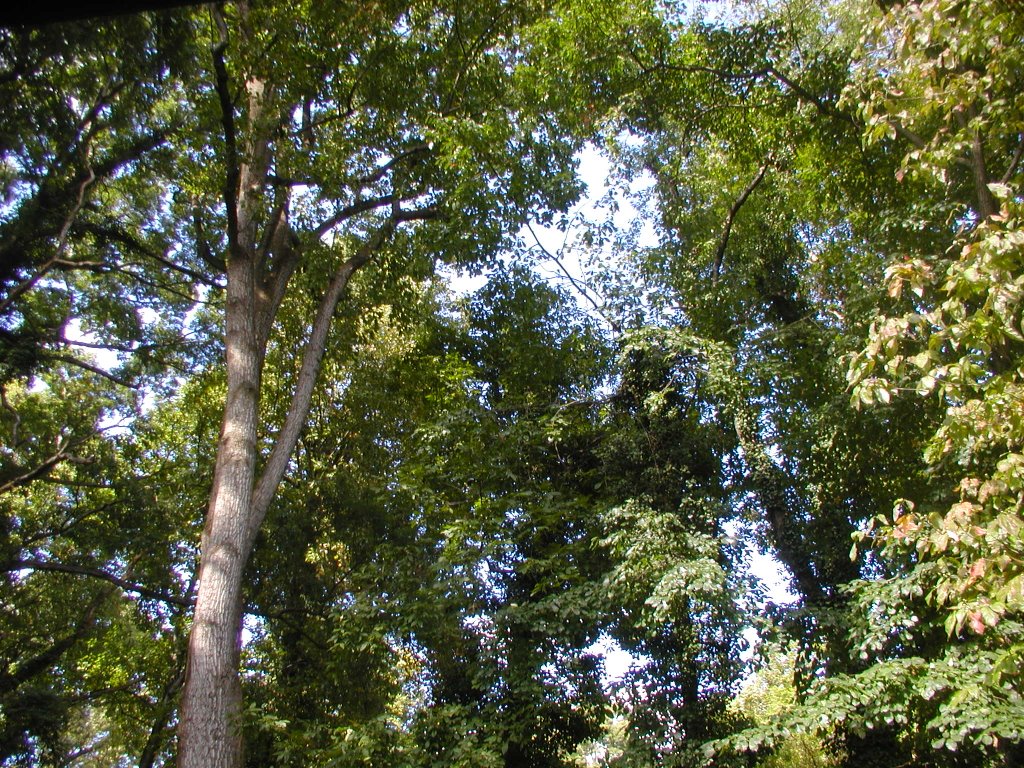 Nothing of substance to say today except thank god it's Fall. The weather has cooled down, the windows are open and somewhere down the street grass is being cut and the smell is blowing around in here. The sun is out, the sky is blue, the leaves are just beginning to turn. It's only 64/17 degrees outside and the week is finally over.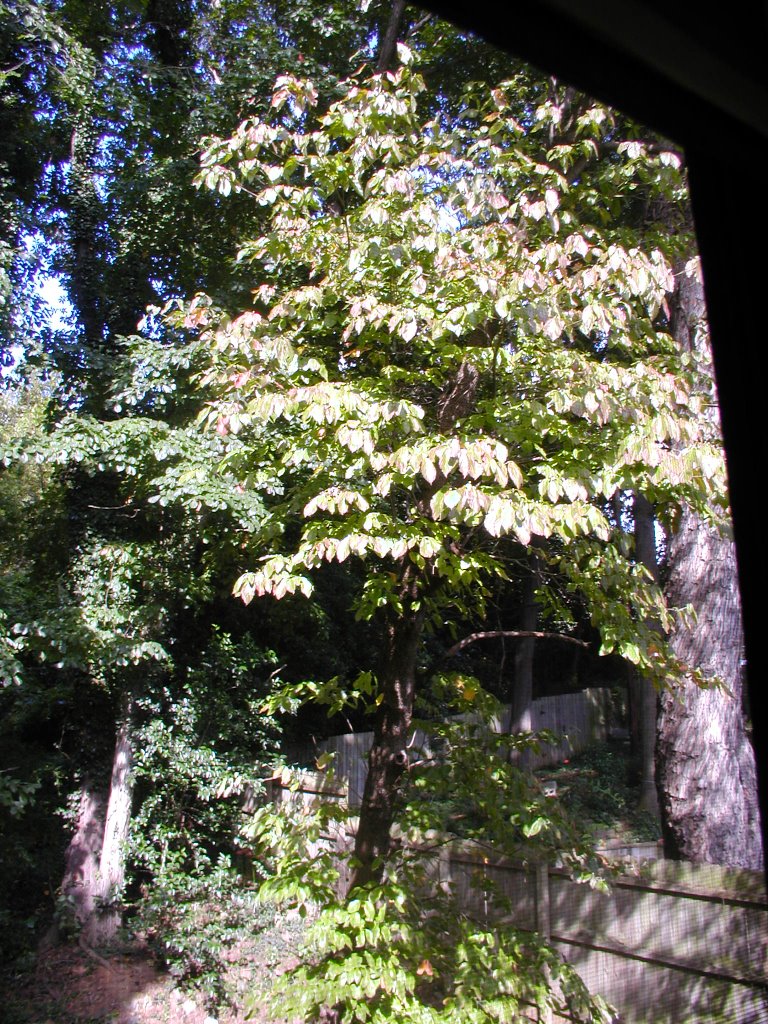
There is at least one good thing about this place: it's gorgeous this time of year. There are so many hills and trees and wildflowers, and it often amazes me how lush everything looks poking up through the red clay soil. Some of my colleagues and I are planning to drive up to the mountains (no more than an hour away) towards the end of October when the fall color fully emerges. We'll hike along some of the trails, and wander around the hippie-artist-bluegrass city nearby buying used books. I'll be sure to take some photographs and post them here.
But for now, before I travel anywhere, it's nice to sit in my sun-filled dining room listening to the trees rustle in the breeze.
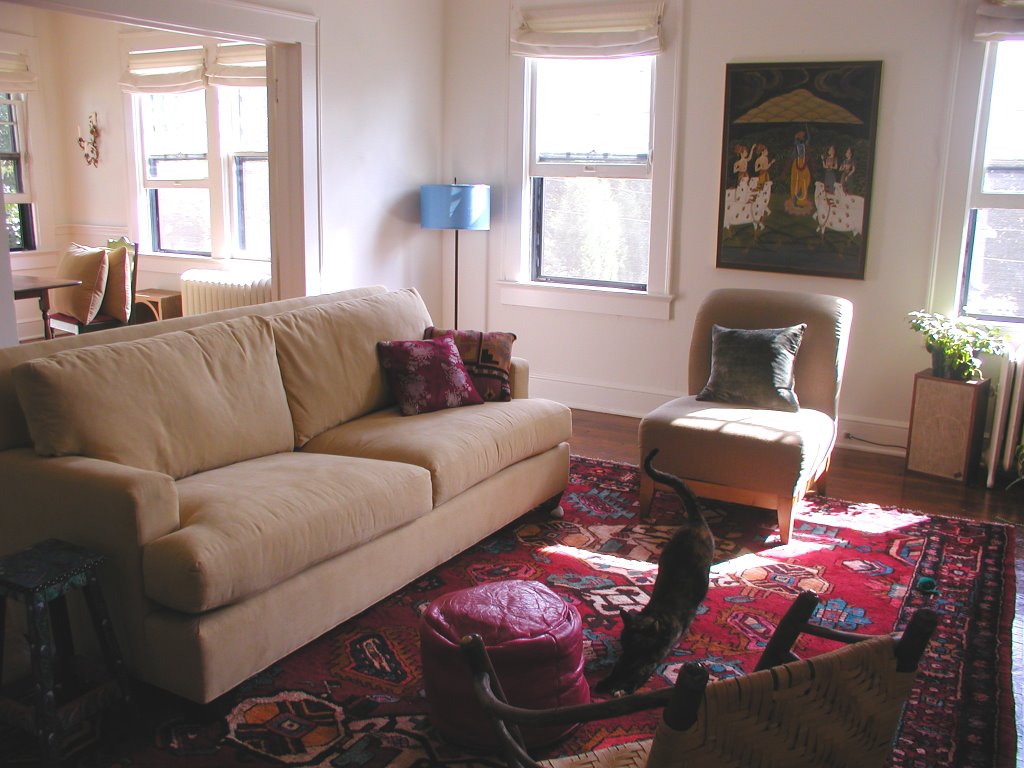 I took these photos today, looking out the bedroom window and standing in front of the bookcases in the living room.
Notice the very grown up looking sofa. The color turned out darker than I expected, more golden. But I like it better that way.
Monday, September 25, 2006
Vintage Cuban Movie Posters

I've just acquired some lovely vintage Cuban Movie posters. They are large and colorful. They are somewhat witty. I can't wait to frame them and put them on my walls. My favorite one is "Vampiros en la Habana" (Juan Padron, 1986). Look at that Cuban vampire. He's relaxed. He's even a little sleepy. He's happy. He's smoking a Cuban cigar. Not a care in the world. Oh, to be a vampire in Havana!
In all Propriety!
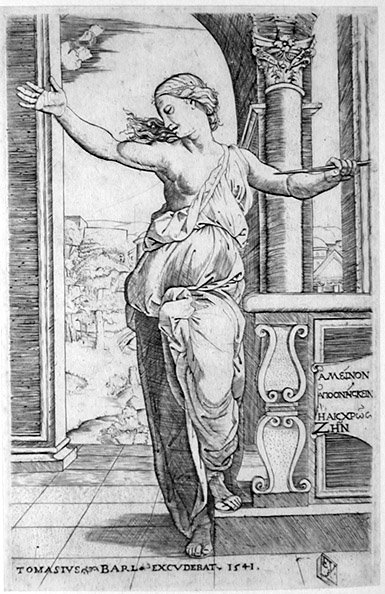
I've recently received some notes of concern regarding the original picture I selected for my profile (it is no longer available for viewing on the web). Apparently some folks thought it looked a little over-exposed, if you get my gist. It wasn't. But the fear that it might have been has caused me to meditate on what it means to be a woman with a not-very-anonymous blog.
Why do people tend to worry/assume that women who expose their thoughts on the web in blogs and elsewhere might also be baring too much photographically? No one wonders whether maybe male bloggers are showing too much in their photographs (below the waist).
Thinking about this also makes me think about a separate but related issue: the fact that my freshman survey students needed to be reminded to call me by my title and not "Miss" or "Ms." This would almost never happen to a male college professor, no matter how young. If you disagree, fine, let me know. I'm happy to be told otherwise, but I suspect your examples will be few and far between.
The worst part is that I felt compelled to take the original picture down, even though I know there's nothing wrong with it. Because now I'm feeling incredibly self conscious.
I've decided to replace the profile picture with something better. So there's no question of whether or not I'm "flashing a breast."
Ok, so maybe I over-reacted. Blame it on the upper respiratory infection. Don't worry, admirers, I'll get my vanity back and post some more pictures of me when the time comes. But I'm still experimenting with just how anonymous I can be on the web and still be myself and still write truthfully. For now, I'm going to be a Renaissance engraving.
Saturday, September 23, 2006
Fever Blogging
Nothing much to say today, except that it's the Jewish New Year and I am too sick to enjoy it. I knew something was coming on yesterday when I woke up with a sore throat and a funny taste in my mouth. Today I woke up with bowling ball head and not only a sore throat but that strange skipping thing your throat does when you swallow and you can't feel it half the way down. And the sense that every little task I had to do, take a shower, close the windows, turn on the ac, get the mail, was somehow too complicated to manage.
I don't have a very high fever, but it's there. Poor Saffron sees me lying on the bed trying to read a book when it's gorgeous and breezy (albeit hot: Indian Summer here) outside and thinks I'm just a lazeabout and should really be entertaining her. The plaintive mews come about every 7 seconds.
I've taken Ibuprofen, so hopefully I'll start to feel better. Usually Rosh Hashana is a day to go for a nice walk, contemplate the turning of the year through the turning of the leaves and the season from summer to autumn, relax, take a day off from work. Today would be a good day for that. 84/28 degrees outside, sunshining, breezy.
Feh.
I don't have a very high fever, but it's there. Poor Saffron sees me lying on the bed trying to read a book when it's gorgeous and breezy (albeit hot: Indian Summer here) outside and thinks I'm just a lazeabout and should really be entertaining her. The plaintive mews come about every 7 seconds.
I've taken Ibuprofen, so hopefully I'll start to feel better. Usually Rosh Hashana is a day to go for a nice walk, contemplate the turning of the year through the turning of the leaves and the season from summer to autumn, relax, take a day off from work. Today would be a good day for that. 84/28 degrees outside, sunshining, breezy.
Feh.
Thursday, September 21, 2006
Academic Maturity or, "John Donne: Still Sexy after all these Years"

Neither of my classes is ever dull, but the level of maturity of my more advanced students sometimes blows me away. It amazes me that in three to four years students can grow so much.
Today, despite only four hours of sleep, my upper level Renaissance poetry class basically rocked. Not because of my level of preparedness (or lack thereof) but because they were so excited by the material and said such smart things. I, on the other hand, appeared sleepy, sniffly (allergies) and groggy. But it was ok. Sometimes we have not-so-good days in the classroom and we suffer through them. Other times, we think we'll have to suffer through class and our students lift us up. We continued our discussion of Donne's Songs and Sonnets, examining Reformation rhetoric alongside imagery of material decomposition. We also continued our on-going discussion of gendered rhetorical stances. And somehow, through all of this wrestling, pondering and arguing, we ended up acknowledging that most of us would probably allow ourselves to be seduced by J.D., because of his cleverness, his wit and the way he seems to keep "pushing it almost just a little too far" as one of my students put it. Another had this to say: "His rhetoric is violent and misogynistic and I'm totally grossed out by his morbid imagery, but you have to admit that he's still sexy after all these years."
When a student gave a presentation on Donne today and mentioned Donne's punning on "Death" as a euphemism for orgasm, no one blinked. If I had brought that up in my freshman survey, I think there would have been a mixture of giggles, squirming, and lips pursed together in shock.
I don't know if the reason why this kind of discussion could never take place in my freshman survey class has to do with the students' age or wisdom. Is the maturity of my advanced students simply an ability to acknowledge and relish contradiction within a text? Or is it an ability to be comfortable talking about sex and literature and ideology all at once? Or maybe they are simply used to us crazy English teachers sexing up our readings?
I chose a picture of the young Donne for this post. It's dated 1591, and he looks quite innocent and a little anxious (notice the hand gripping the sword hilt, the raised shoulders). Not at all seductive, if you ask me, though I do think his nose is cute. He should ease up on the eyebrow plucking, though.
Tuesday, September 19, 2006
Prudentia
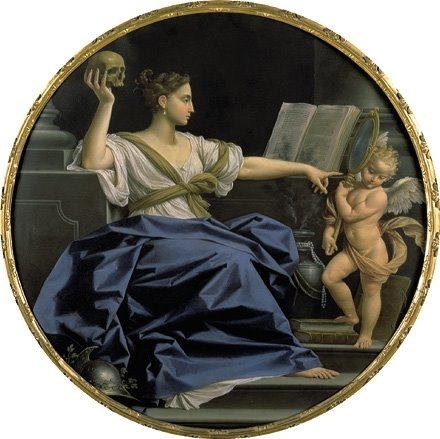
My mom sent me this image today as a quesiton that she later answered herself. Is it Venus (because Cupid is holding up the mirror)? No, it's Donato Creti's allegory of Prudence, and the figure is La Prudenza (late 17th century), who is able to overcome vanity or fancy (represented by the putto holding a mirror) with knowledge and awareness of death (represented by the open book and the skull).
Hmm. Actually it looks more like she's about to lob the skull at whatever she sees in the mirror, which would kind of defeat the purpose. In other words, if you're prudent, then you know what you see in the mirror is an illusion, all is vanity, so smashing it would be to confuse the image with reality. Besides, breaking a mirror means bad luck for seven years, and it's a mess to clean up.
Or, put another way (courtesy of Muse Maman), "So if you can read and look in the mirror and fling a skull at the same time, you must be Prudent?"
Don't say she's just holding the skull up in opposition to the mirror. What a boring interpretation. Dull, dull, dull. You get a B minus for not taking enough risks in your reading. This skull was made for flinging, and flinging's what it'll do. One of these days, It'll fling all over . . . yes, well, turns out she's not very prudent at all, is she?
Originally, I thought the image was a nice reminder of what I'm trying to do here, i.e, trying not to let my rampant imagination dominate my thoughts and get in the way of my scholarly exercises.
But I've never been one to smash my imagination. The imagination is what fuels my scholarship. I'd like to keep the mirror up there. And I don't need to do away with Cupid either, he's not hurting anyone. Come to think of it, the skull's important too, especially to my work. Let's just try to keep our skulls away from our mirrors, shall we?
Saturday, September 16, 2006
I Would Prefer Not To
Today the temptation to peruse the Job list, which recently went live two days ago, was very strong. Supposedly it is blooming with jealousy-inducing early modernist jobs. Oscar Wilde said: "I can resist everything but temptation."
But I resisted.
I won't I won't I won't I won't look at that list.
Just thinking about ever applying for anything again, interviewing, suddenly wanting something so badly, and if I'm lucky moving, oh god, moving, fills me with anxiety.
I'm also receiving my first invitations to apply for jobs this year. When I got the first e-mail I started to have a panic attack, instead of sitting back and feeling flattered. Maybe this is due in part to being in my first month of a tenure-track job: what doesn't cause a panic attack, at this point?
So if you ask me whether I've seen the job list, the answer is that I would prefer not to.
Whether I can restrain myself is a different quesiton entirely.
I certainly haven't been very good at restraining my imagination these days. Today especially.
But I resisted.
I won't I won't I won't I won't look at that list.
Just thinking about ever applying for anything again, interviewing, suddenly wanting something so badly, and if I'm lucky moving, oh god, moving, fills me with anxiety.
I'm also receiving my first invitations to apply for jobs this year. When I got the first e-mail I started to have a panic attack, instead of sitting back and feeling flattered. Maybe this is due in part to being in my first month of a tenure-track job: what doesn't cause a panic attack, at this point?
So if you ask me whether I've seen the job list, the answer is that I would prefer not to.
Whether I can restrain myself is a different quesiton entirely.
I certainly haven't been very good at restraining my imagination these days. Today especially.
Thursday, September 14, 2006
Terrible News from Montreal
This news is terrible: Shooting at Dawson College in downtown Montreal .
Jonathan has written well about it over on his blog. There are also first-hand accounts on Metroblog, and Pantagruelle posts on the subject, wisely pointing out the necessity of gun control. I was actually shocked to learn that Canada doesn't have tougher gun control.
It's pretty terrifying. Most of all because Montreal is supposed to be a safe place, and schools are supposed to be safer places inside a safe place.
Now maybe they'll have to install metal detectors and security guards and people will be scared going to school to teach and learn. And people will be scared walking the streets of Montreal.
One of the things I loved about living in Montreal was how much safer it was than big American cities.
I really hope it stays safe, despite this horrific incident. But once they add the necessary metal detectors and security guards, it certainly won't feel the same.
Nonetheless, life, and learning go on. Sometimes, as a close friend said in response to yesterday's trauma, you just have to open your books and keep teaching. And I do think that is perhaps the best thing to do.
Jonathan has written well about it over on his blog. There are also first-hand accounts on Metroblog, and Pantagruelle posts on the subject, wisely pointing out the necessity of gun control. I was actually shocked to learn that Canada doesn't have tougher gun control.
It's pretty terrifying. Most of all because Montreal is supposed to be a safe place, and schools are supposed to be safer places inside a safe place.
Now maybe they'll have to install metal detectors and security guards and people will be scared going to school to teach and learn. And people will be scared walking the streets of Montreal.
One of the things I loved about living in Montreal was how much safer it was than big American cities.
I really hope it stays safe, despite this horrific incident. But once they add the necessary metal detectors and security guards, it certainly won't feel the same.
Nonetheless, life, and learning go on. Sometimes, as a close friend said in response to yesterday's trauma, you just have to open your books and keep teaching. And I do think that is perhaps the best thing to do.
Tuesday, September 12, 2006
La Petite Domestique
 I'm still feeling very domestic, still working on my apartment.
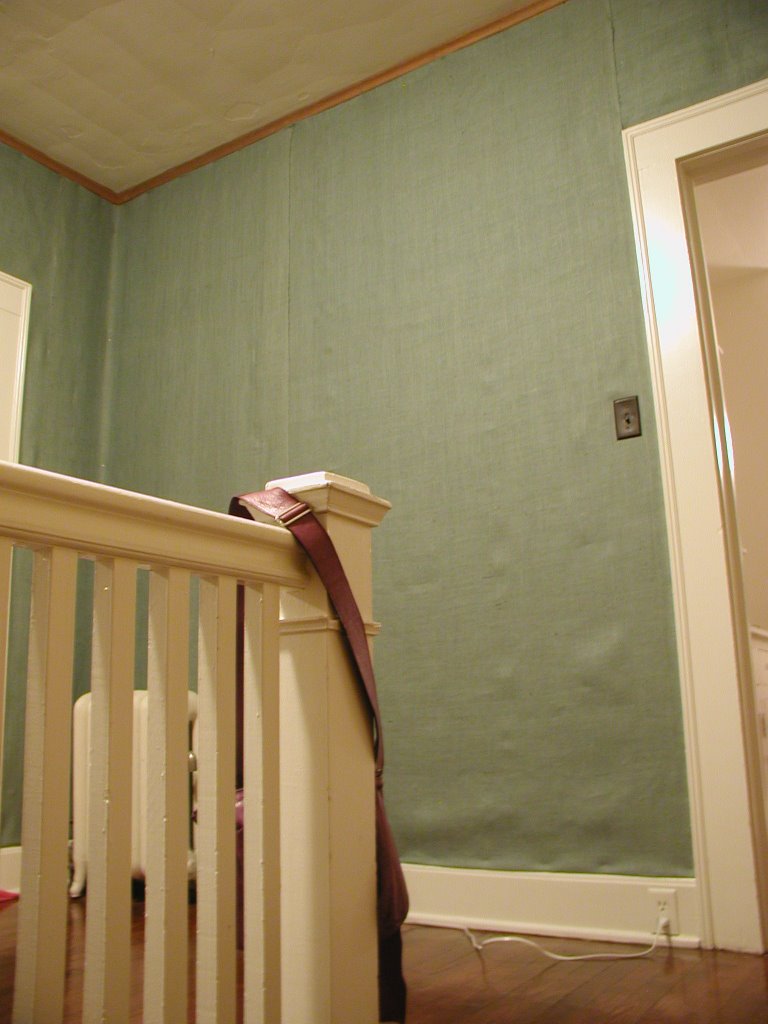
Two new things happened-- I started to cover the ugly 70s paneling and my mod Saarinen style kitchen table arrived. So here are some new views of the hall and the breakfast nook. It's amazing what one can do with a staple gun and some burlap!
The hall walls are actually a kind of pale 18th century dirty turquoise, like a robin's egg, but it looks darker than usual because it was nighttime and the flash was on.
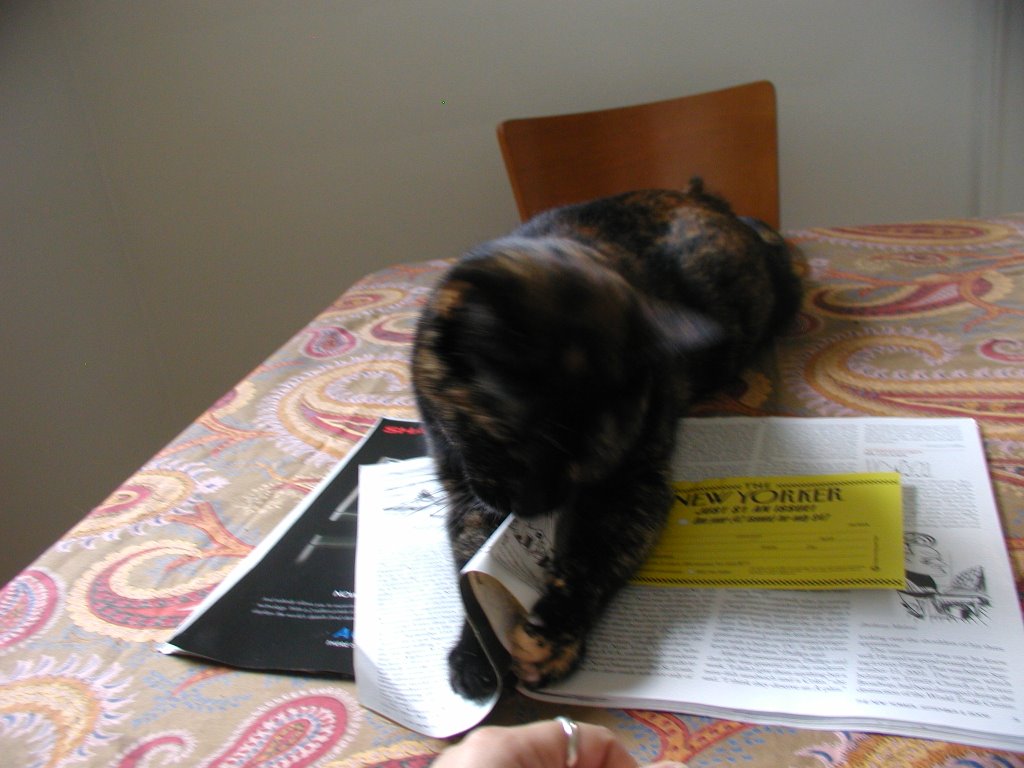
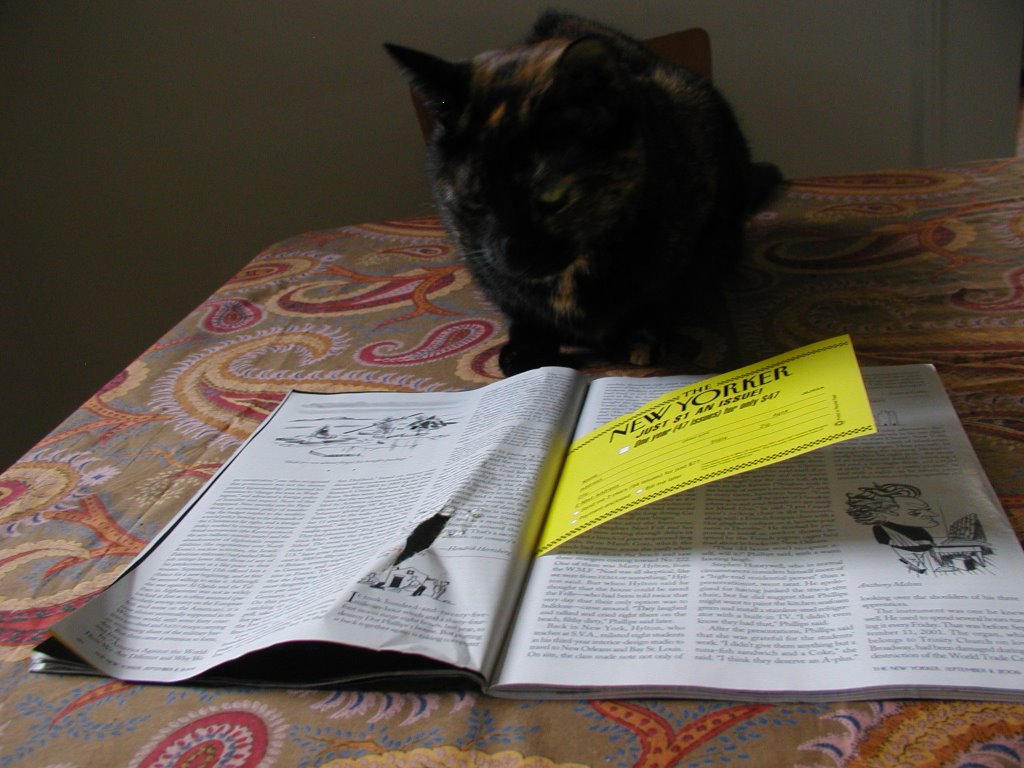
Oh, and here is Saffron engaging in some decoupage. You see, I'm not the only one in the house being crafty:

To Autumn
 I love autumn, especially the harvest. And it's on its way.
This past Sunday I went to the farmer's market, about 20 minutes out of town on the way to the airport. It was quiet and smaller than on most days, but it was still in full swing. There were plants, flowers, flowering plants, fruit, vegetables, fruiting and vegetable-ing plants, and fresh churned butter.
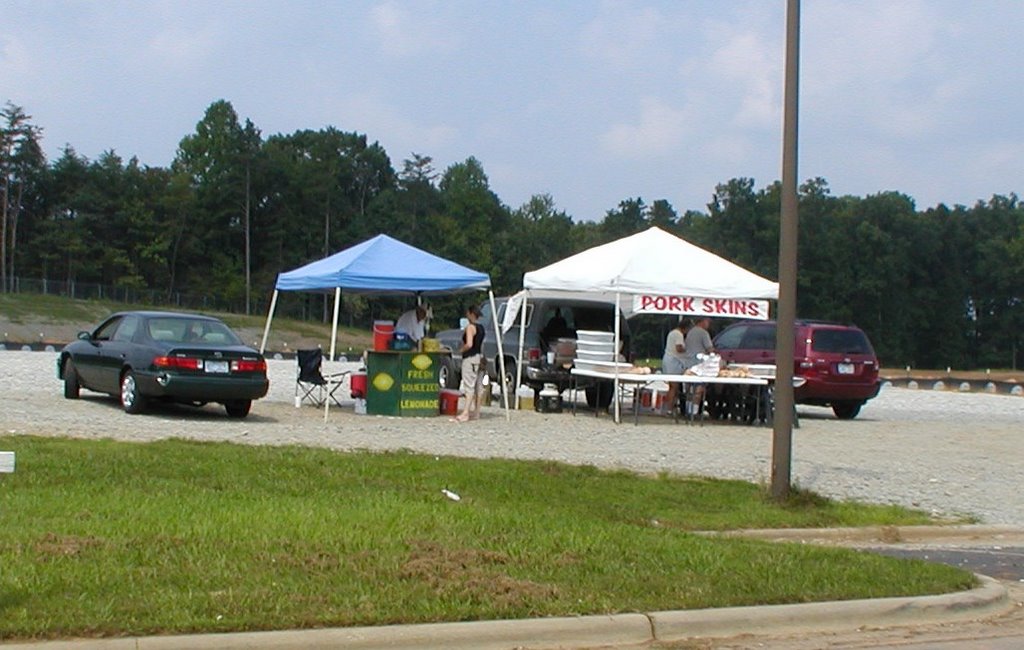
So there weren't any crepes, Algerians selling olive oil and tagines, or a Baji lady. But the South has its own specialties: fresh squeezed lemonade and pork skins! Here's a picture of my colleague getting some lemonade. The lemonade guy was awesome. All he wanted to do was talk. It turns out he has a son in Massachussetts, where my friend got her Ph.D. And he went to law school where we teach. And he had this wonderful, kind of formal way of speaking, which I later learned is sometimes called "High Southern."
 Also there were lots of apples and pears, varieties I had never heard of including a monstrous giant apple, mostly green with some red, kind of lumpy actually, a little obscene, really, called "Adam and Eve." Mixed apples and pears for $4 a peck. A peck, it turns out, is a smallish paper bag (about 8 apples). We were surprised to see so many apples, but we surmised they came from the Mountains, where it's cooler (NB it's already started to cool down here and is in the lower 60s tonight). The ones we bought were definitely from the mountains.
There were also pink and yellow speckled beans, which I remembered seeing at Jean Talon in Montreal. Here, they're called "October Beans." Not to mention baby vidalia onions and the biggest heirloom tomatoes I have ever seen for the lowest price, $1.29 a pound (see photo below right).
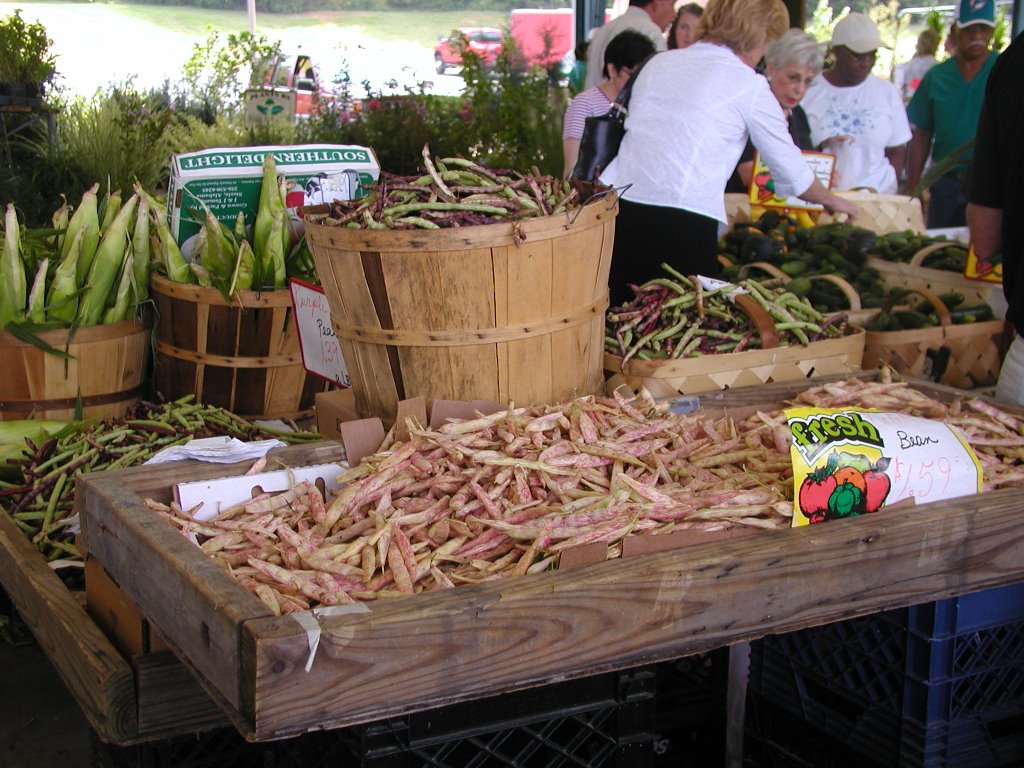
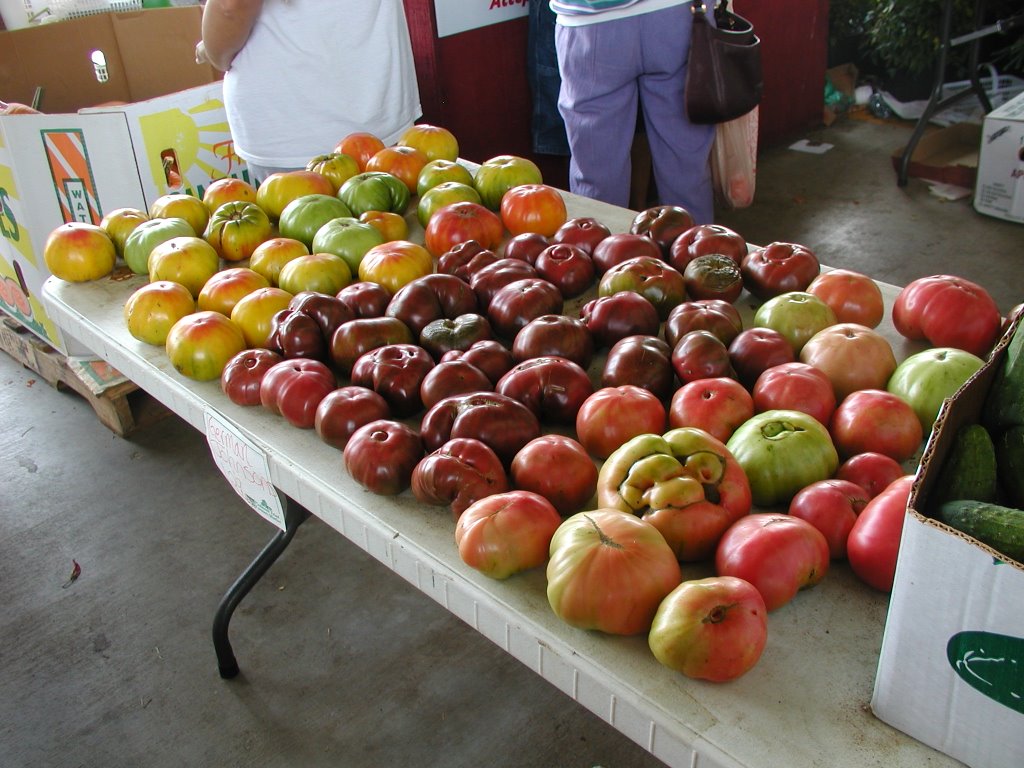
The number of things you can plant in the ground here that will actually grow is fairly remarkable. My friend bought two large-ish hibiscus trees at $5 each. We also saw large fruiting fig trees, heavy with little yellow-brown local figs ripening on their branches. They were $25 each and we both went home planning to research whether we could plant them in our backyards or in pots and have them fruit next summer. There were pots of Carolina Crepe Myrtle everywhere, which looks like a tall fuschia lilac tree and flowers all summer (there are two right outside my house in bloom when I arrived a month ago and still going strong), as well as the divine trumpet vine, which releases its creamy scent only at night.
In the end, I returned with the ingredients for an amazing summer's end gazpacho, two bouquets of flowers, a smile on my face, and a craving for a fig tree. Here's how the farmer's market dahlias have enhanced my apartment:


Subscribe to:
Posts (Atom)